
Yakima Previous-Resident Source Eras
A backward address trail works best when each source is used for the period and fact it can support. The Assessor provides today's parcel context. The Auditor supplies recorded transfers. Printed directories and maps add dated household and building clues. Archives carry the search beyond what a live portal can show.
| Source | Years covered | Where held | What it shows |
|---|---|---|---|
| AVA deed index | August 1, 1985 forward | Yakima County Auditor | Indexed parties, dates, instrument clues |
| Online deed images | Generally February 23, 1997 forward | AVA and copy services | Recorded instrument when available |
| Yakima city directories | 1908-2012, with gaps | State Library, YVL, other collections | Dated names, addresses, and printed roles |
| North Yakima directories | 1908-1911, 1913, 1917 | State Library holdings | Entries under the former city name |
| Sanborn maps | 1888, 1920, and 1950 sets | Library of Congress | Footprints, lots, alleys, and building use |
These ranges describe known holdings or access layers, not a promise of an unbroken resident list. Start with the newest reliable source and move toward older material.
Start With Yakima's Parcel Card
The Characteristic Parcel Search can show parcel number, situs address, current owner display, abbreviated legal description, tax-code area, neighborhood, building details, and excise transactions. Save all of those fields before searching a name. The parcel and legal wording are stronger continuity checks than a street string, which may change.
Excise fields can include a number, grantor, date, price, document type, parcels sold, and a link to included properties. An excise row is a clue to the transfer, not a substitute for the deed. Values and exemptions describe assessment treatment, not who lived inside the property.
For the current street-by-street method, use the Yakima County street directory. Previous-resident research keeps its focus on one parcel moving back in time.
Walk Yakima Deeds Backward
The Yakima County AVA index is the free starting point. Search the newest transfer, compare the parcel and legal description, then use the seller's name to locate that person's earlier purchase. Repeat the chain only while the land description remains consistent.
- Copy the current parcel number, situs, owner, and abbreviated legal description.
- Find the owner's purchase instrument and save its number, date, grantor, grantee, and type.
- Search the seller as a prior grantee to find an earlier purchase.
- Compare lot, block, subdivision, parcel references, and any portion indicator.
- At the online cutoff, ask the Recording Division for microfilm or older office records.
- Grantor
- The party transferring an interest in the recorded instrument.
- Grantee
- The party receiving that recorded interest.
- Chain of title
- The linked sequence of transfers for the same property interest.
- Legal description
- The land wording used to distinguish the parcel from a changeable street address.
A same-name match alone is not enough. Trusts, entities, family members, partial transfers, mergers, and parcel splits can interrupt a simple chain.
The Yakima Index-Image Divide
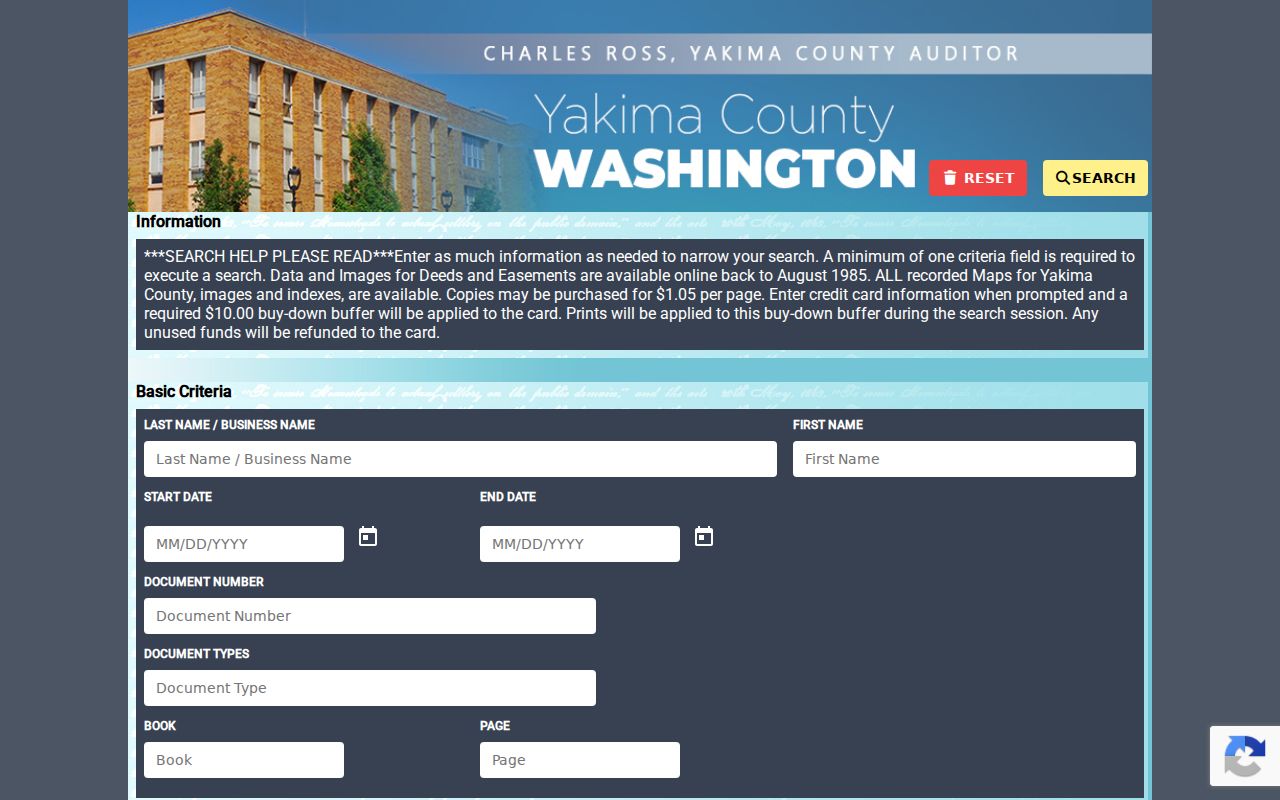
The Auditor says deeds and easements are indexed back to August 1, 1985. Electronic imaging began in February 1997, and images generally start on February 23, 1997. An instrument between those dates may appear in the index while its image remains on microfilm. Previous residents can therefore leave a valid recorded trail even when the browser offers no page image.
The Researching Documents page lists all channels. AVA is free. Official Records Online handles orders, Tapestry charges $8.95 per search plus $1 per printed page, and Laredo Anywhere requires a subscription with a six-month minimum. Unlimited in-office searching is available at 128 N 2nd Street, Room 117 during listed weekday hours of 9:00 a.m. to 4:00 p.m. Mail and in-person copy requests are also accepted. Regular copies cost $1 per page; certified copies cost $3 for the first page and $1 for each extra page. Online orders add $10.
Inspect the official AVA portal before using this reference image.
Separate Yakima Owners From Occupants
A deed names parties to a property transfer. It does not list every person who occupied the building. An Assessor owner may live elsewhere, use a representative, or hold title through a trust or entity. A permit applicant may be a contractor. A directory line is a publisher's dated statement and does not prove ownership.
Use at least two independent sources before describing a likely past resident. Pair an owner with a city-directory line, census entry, newspaper notice, obituary, or another dated record. Phrase the result narrowly: the deed supports ownership on a date, while the directory supports a printed address for its edition. Do not merge the two into certainty when dates conflict.
Key distinction. Old owners and previous residents overlap at times, but Yakima County records do not make them the same category.
Pair Yakima Directories and Maps
The State Library lists Yakima city-directory holdings from 1908 through 2012 with gaps, plus North Yakima volumes for 1908-1911, 1913, and 1917. Search both names. A county volume may also reach Moxee, Selah, Sunnyside, Toppenish, Wapato, Zillah, and other valley communities omitted from a city heading.
- Choose the directory year closest to the deed or event date.
- Search surname variants, initials, Yakima, North Yakima, and the surrounding community.
- Save the printed name, address, heading, year, publisher, page, and call number.
- Compare an adjacent directory year to test a move or publication gap.
- Match the address to a deed, map footprint, census schedule, permit, or newspaper.
The full shelf and its access rules belong to the Yakima County city directories page. Here, each volume serves as one dated step in an address trail.
See Yakima Buildings Across Time
The Library of Congress provides an October 1888 North Yakima map, an 87-image 1920 Yakima set, and a 1950 Yakima set. These fire-insurance sheets can show footprints, construction, use, lots, alleys, and nearby structures. They generally do not name every occupant.
Compare the same block across editions. A matching footprint can support continuity when a street form changes, while a replaced structure warns that the address history may involve different buildings. The Fruit Row preservation research shows how Yakima historians join maps, directories, newspapers, and property records without asking any one source to prove the whole story.
Use Yakima Local Archives
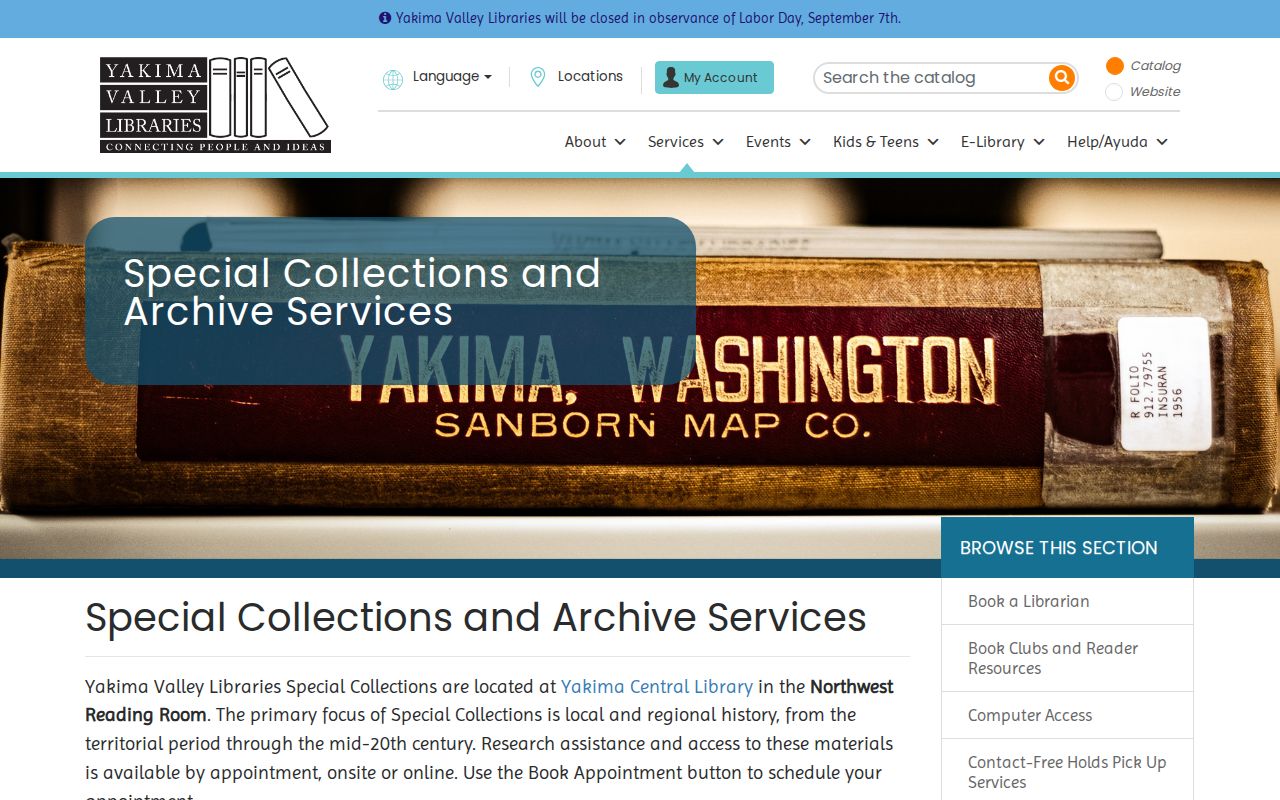
Yakima Valley Libraries Special Collections offers the Northwest Reading Room, Relander papers, maps, atlases, newspapers, microfilm, yearbooks, Yakima Memory, and research help onsite, online, or by appointment. Those sources can connect previous residents to a school, business, civic notice, obituary, or dated local event.
The Yakima Valley Museum archive adds about 12,000 photographs, 200 maps, 95 oral histories, newspapers from 1890-1952, transportation records, local papers, and architectural material dating roughly from 1900 into the 1960s. Appointment-oriented access is useful when an old property cannot be resolved in the online index.
Review the YVL collection description before planning a request.
Resolve Old Yakima Address Names
The county seat moved from Yakima City, now Union Gap, to North Yakima in 1887. Modern Yakima is the later name. An early deed, court item, directory, or map may therefore use a place heading that looks wrong in a modern search. Preserve that old label and search its variants.
No authoritative block-level Yakima renumbering event was verified in the research. When numbers conflict, compare the legal description, lot and block, building footprint, intersection, and permit or tax history. Ask city engineering or code staff, county GIS, or the Recorder to confirm an official change. Do not derive a date from one failed text search.
Handle Yakima's Historic Gaps
An 1882 courthouse fire destroyed district-court records then held in Yakima County. A missing early case may reflect that loss, not the absence of a person. Surviving civil and criminal series, probate beginning in 1874, later Clerk files, microfilm, newspapers, Auditor records, and Central Regional or State Archives holdings can provide alternate evidence.
This local quirk matters when probate or litigation should close a previous-resident trail. Record the negative search honestly. Then pivot by record type rather than asserting that no event took place. The same discipline applies to gaps in printed directory years and online deed images.
Log Yakima Previous Residents
For each step, save the source, query date, exact printed spelling, instrument or page number, date covered, address wording, legal clue, image status, and confidence level. Separate facts from conclusions. Mark unresolved changes and the next office or collection to consult.
- Current parcel and situs form
- Transfer parties, type, date, and instrument number
- Directory title, year, heading, and page
- Map edition, sheet, footprint, and nearby landmark
- Permit, newspaper, archive, or probate citation
This log makes a claim about who lived here before traceable and correctable. It also prevents a modern name from being placed at an old address without dated support.
Lawful use. Research previous residents for house history, family history, or lawful personal inquiry. Never use it to track, stalk, harass, threaten, or harm a living person.
Close a Yakima Household Trail
An obituary, probate file, or death index can explain why a name leaves an address trail. Washington Digital Archives has searchable Yakima County birth returns from 1891 through 1907 and death records from 1896 through 1907. Modern death certificates follow Department of Health rules, while probate belongs with the Yakima County Clerk and Odyssey case information. A public index entry may be visible even when its image or certified copy is restricted.
Match the name, date, relatives, place, and record role before linking the event to the parcel. For probate, note the case number and request the official file from the Clerk. For an archival item, retain the collection title and catalog citation. This check may identify an heir or explain a transfer, but it never replaces the deed as proof of the land transaction.