
Yakima Directory Runs by Year
The Washington State Library catalogs both city and county runs. Its list shows that the Yakima city sequence starts in 1908 and extends, with gaps, through 2012. The separate county series follows nearly the same early pattern but ends with 1991 in the published holdings list. These are years held, not a promise that each book is online. A researcher may need a catalog citation, a microfilm request, or help from a local reading room.
| Collection | Years represented | Where held | Access route |
|---|---|---|---|
| Yakima city directories | 1908-1911; 1913; 1917-1925; 1927-1935; 1937-1941; 1951; 1953-1959; 1961-1962; 1964-1989; 1991-2012 | Washington State Library | Catalog and limited appointment access |
| North Yakima directories | 1908-1911; 1913; 1917 | Washington State Library | Catalog request |
| Yakima County directories | 1908-1911; 1913; 1917-1925; 1927-1935; 1937-1941; 1951; 1953-1959; 1961-1962; 1964-1989; 1991 | Washington State Library | Catalog and reading-room request |
| Local directories, newspapers, maps, and yearbooks | Territorial period into the twentieth century | Yakima Valley Libraries | Onsite, online, or by appointment |
Missing years must stay marked as gaps. They may reflect publication, collection, or access limits. They do not prove that a person left Yakima County. Search the nearest edition on each side and then move to a newspaper, census, deed, or yearbook.
North Yakima Changes the Search
One Yakima city directory search often needs three place names. Yakima City, now Union Gap, was the early county seat. The courthouse moved to North Yakima in 1887, and North Yakima later became Yakima. Catalog headings, maps, directory title pages, and newspaper references preserve those older names.
Search the same surname under Yakima, North Yakima, and Union Gap when the date or county-seat link warrants it. Keep each source's wording in the notes. Do not silently replace an old heading with a modern name because the printed heading helps explain which area and publisher scope were meant. This is especially important around the transition from an early North Yakima title to a later Yakima city and county edition.
Polk's 1918-19 Yakima Volume
The State Library catalog identifies R.L. Polk & Co.'s 1918-19 Yakima city and county directory as a precise source object. It includes Yakima and communities such as Moxee, Grandview, Granger, Mabton, Selah, Outlook, Sunnyside, Toppenish, Wapato, and Zillah. Its genealogy microfilm call number is GEN MICRO 979.755 DIRECTORY YAKIMA 1918-1920, and the catalog marks it for library use.
That broad place list matters. Someone absent from the Yakima alphabet might be filed beneath a smaller town, rural heading, business, or county section. A later 1939-1951 Polk catalog record also covers Yakima, Sunnyside, Toppenish, and county residents. Record the title, publisher, edition, call number, heading, and page so another researcher can repeat the search.
Decode a Yakima Directory Line
The available official catalogs establish years, towns, publishers, and access, but the research did not verify a scan of a named Yakima person. Therefore no invented sample belongs here. A real entry should be transcribed exactly, including punctuation, abbreviations, heading, and any cross-reference. Photograph or copy the volume's abbreviation key before interpreting a short code.
| Printed name | The spelling and order used by that edition |
|---|---|
| Work or business line | An occupation, firm, trade, or institution when the publisher printed it |
| Address field | A street, mailing address, rural route, or business location, depending on the section |
| Heading | The town, county, household, business, or telephone grouping |
| Source identity | Year, edition, publisher, page, and catalog or reel number |
These fields show what the publisher reported for that edition. They do not establish title to land or guarantee who slept at the address on publication day.
- Criss-cross directory
- A later directory arranged by street or telephone number rather than only by surname.
- Householder index
- A listing organized around a household name, often separate from firms or institutions.
- Abbreviation key
- The publisher's legend for shortened words and marks; its meanings can change by edition.
Yakima's Northwest Reading Room
Yakima Valley Libraries Special Collections places local sources in the Northwest Reading Room at Yakima Central Library. The collection includes historical newspapers and microfilm, maps, atlases, yearbooks, genealogy resources, the Relander manuscripts and ephemera, Yakima Memory, online exhibits, and Washington Rural Heritage. Catalog results include Polk books, cross-reference editions, and city or county volumes that reach Selah, Union Gap, Wapato, and nearby communities.
Help is available onsite, online, or by appointment. Give staff a surname with variants, an approximate year, a town or street, and the catalog title if known. Ask whether the item is a bound volume, film, digital object, or restricted archive item. The library screenshot below shows the Special Collections access point. It is a practical local fallback when a State Library catalog citation has no online page image.
Open the Yakima Valley Libraries Special Collections page before arranging research.
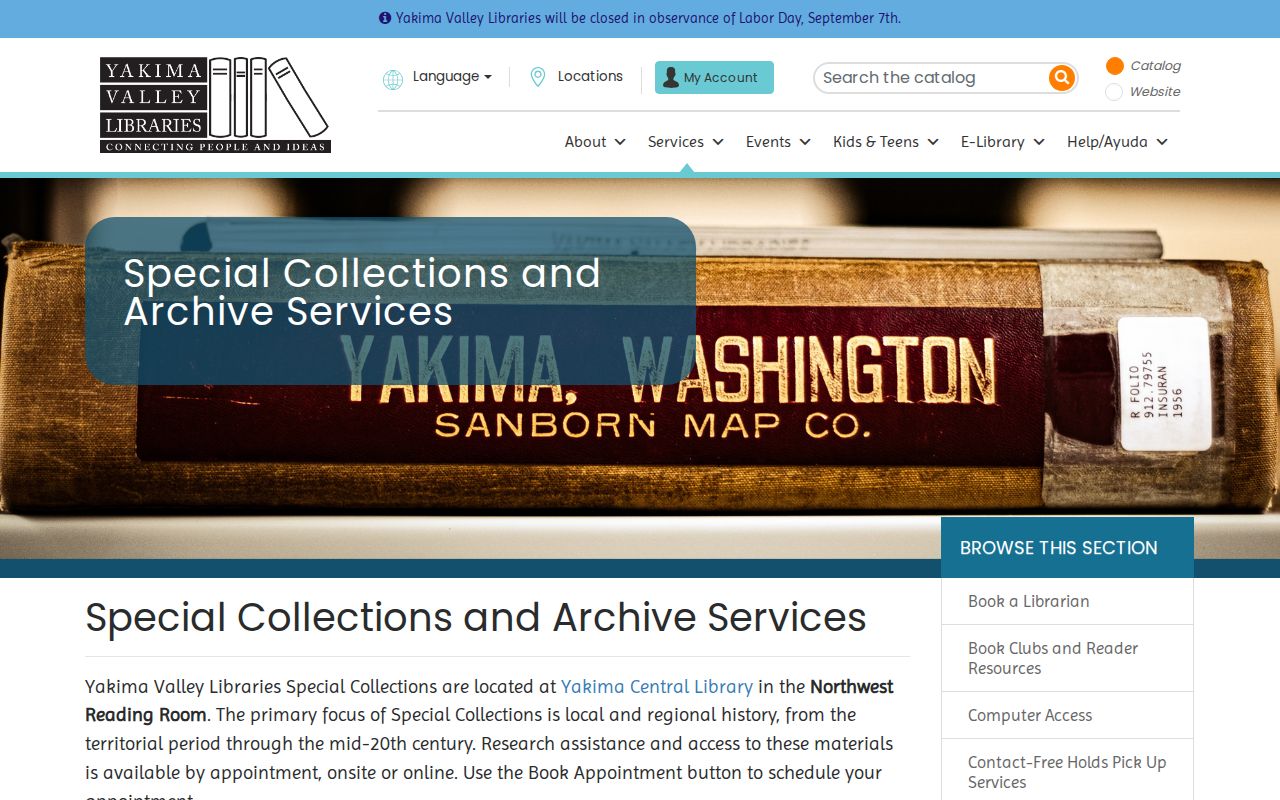
The service page connects the printed directory trail to staff help, local newspapers, maps, yearbooks, and digital collections.
Yakima Museum Adds Local Context
The Yakima Valley Museum's Sundquist Research Library and Archives can extend a city directory hit into a building or community story. Its listed holdings include about 12,000 photographs, 200 maps, 95 oral histories, bound Yakima Herald-Republic volumes from 1890 through 1952, personal and business papers, transportation records, and architectural material from roughly 1900 into the 1960s.
This archive is appointment-oriented. Contact the museum at 509-248-0747 before visiting 2105 Tieton Drive. Ask about a narrow person, firm, building, route, or date rather than requesting every mention of a surname. Donor limits and reproduction rules can differ by collection.
Review the museum library and archives description before requesting an appointment.
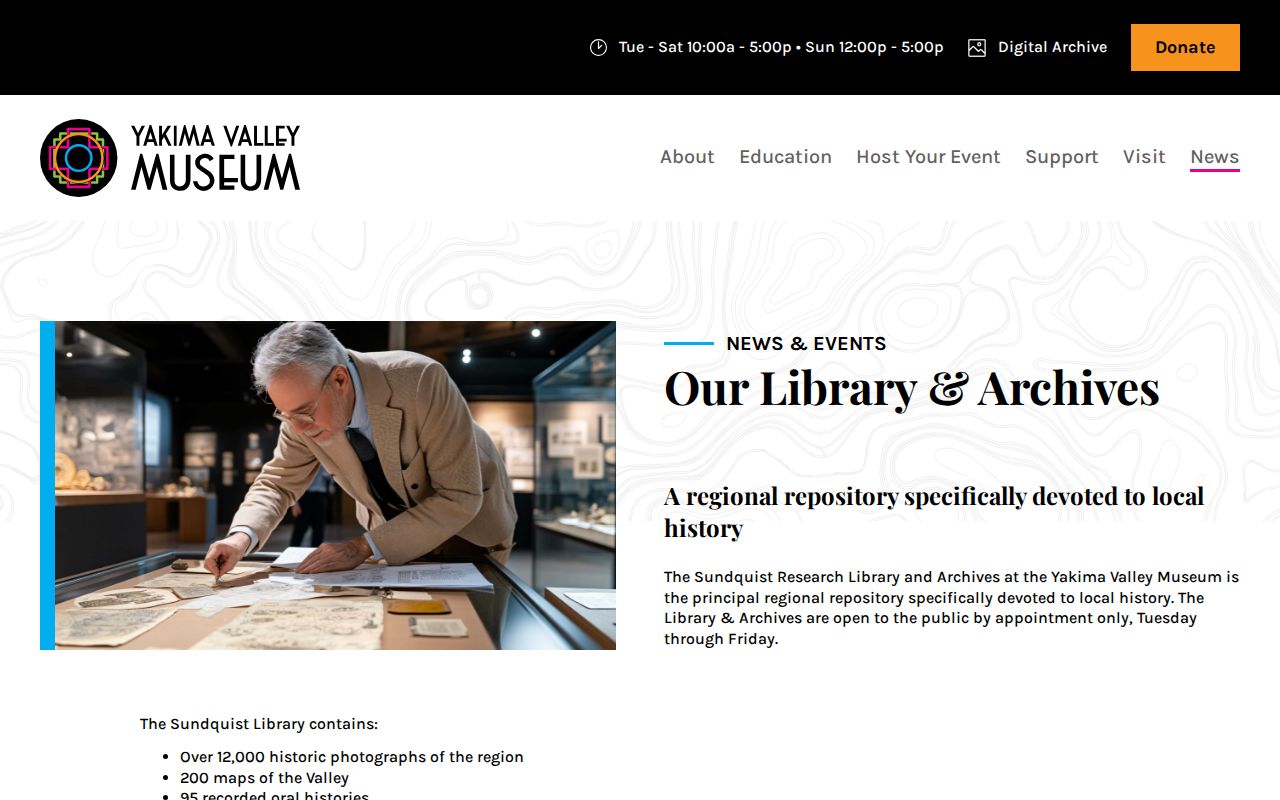
The museum's papers, photographs, transport files, and building records supply context that a one-line directory listing cannot.
Map Yakima Directory Addresses
Sanborn fire-insurance maps can test whether a street, building footprint, alley, or land use matches the address printed in a directory. The Library of Congress provides a North Yakima map from October 1888, an 87-image Yakima set from 1920, and a Yakima set from 1950. The local Fruit Row nomination cites still more early Sanborn dates.
A map is not a list of occupants. Pair its block and building evidence with the city directory line, then seek a deed, newspaper item, photograph, or permit. This comparison is particularly useful when North Yakima and Yakima headings differ or when an old address no longer maps cleanly to today's street display. Preserve the historic address as printed while adding a separate, clearly labeled modern match.
Note: A building match strengthens an address trail, but it does not turn a Sanborn sheet into proof that a named person lived there.
Yakima Directory Research Timeline
Place names, publisher scope, and current reading-room access all shape the search. A short timeline keeps those changes from being mixed together.
| Date | Change affecting a directory search |
|---|---|
| 1887 | The county courthouse moved from Yakima City, now Union Gap, to North Yakima. |
| 1908 | The listed Yakima, North Yakima, and county holdings begin. |
| 1918-19 | The Polk city and county volume names a wide group of valley communities. |
| 1991 | The State Library county-directory run list ends. |
| 2012 | The listed Yakima city-directory holdings extend through this year. |
| July 1, 2025 | State Library public access changed after its closure to general public visits. |
The State Library described limited Thursday appointment access from 1 to 4 and reference help by email after the 2025 change. Recheck those current terms before planning a visit. YVL and the museum are the strongest local alternatives.
Trace Yakima Families Across Editions
City directories fill years between federal census schedules, but each is a separate publisher snapshot. Build the trail one edition at a time. Keep gaps visible, and compare sources that were created for different reasons.
- Start with the closest known year and search the surname, given name, initials, and spelling variants.
- Repeat the search under Yakima, North Yakima, and the relevant county community heading.
- Read nearby years and any street or cross-reference section. Note each move, business line, and changed spelling.
- Compare the address with the nearest census year and a dated Sanborn map. Treat each as independent evidence.
- Use newspapers, yearbooks, deed records, or museum holdings to explain a disappearance or move.
A missing entry can mean the publisher skipped an area, the person was unlisted, the household appeared under someone else, or the collection lacks that year. It should not be labeled a departure or death without another record. For present-day address work, use the Yakima County street directory rather than stretching an old volume beyond its date.